
![[EN]](http://www.idcdermo.com/cdn/shop/files/IDC-SOLIS_FPS50-_1_EN.jpg?v=1744232215&width=240)

![[fr]](http://www.idcdermo.com/cdn/shop/files/creme-solaire-minerale-fps50-teintee.jpg?v=1764342439&width=240)




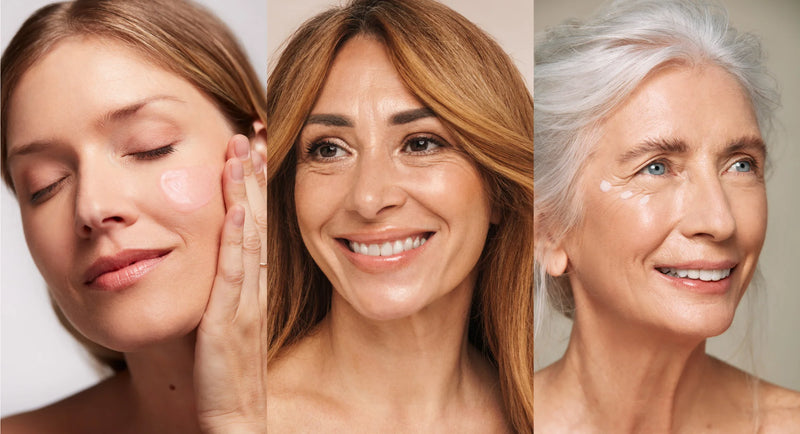
Your skin is more intelligent than you think. It naturally knows how to support itself through hydration and a complex skin barrier system. Children enjoy dewy, plump skin because their barrier performs optimally, retaining moisture and integrity. But as we age environmental exposure and lifestyle habits affect the skin’s natural processes. By our teenage years, hydration is no longer automatic and requires a deliberate daily routine. There’s no ‘one-size-fits-all’ prescription, so let’s explore how to adapt your hydration routine to every stage of life.
How Skin Naturally Stays Hydrated
Around age six, skin thickness and barrier function fully mature, maintaining high surface hydration. The skin's top layers utilize Natural Moisturizing Factors (NMFs)—a cocktail of amino acids, sodium PCA, and lactates—to pull in moisture, fueling the enzymes necessary for healthy cell turnover. Supporting this is the dermis, which acts as a deep reservoir; here, agents like Hyaluronic Acid ensure moisture constantly diffuses upward to hydrate the skin from the inside out.
How Skin Protects Against Moisture Loss
The skin barrier, also known as the epidermal barrier, is one of the primary ways our skin protects itself from passive moisture evaporation, known as trans epidermal water loss (TEWL). More than just a figurative description, the skin barrier is a multi-functional defense system with many responsibilities designed to maintain moisture, protect against TEWL, and shield from external aggressors. Think of your skin barrier not as a single wall, but as a triple-layered security system.
-
Skin Microbiome (biological barrier)
A diverse group of microorganisms that live on the skin, and whose composition is determined by your age, gender, genetics, and lifestyle. This microflora helps defend against ‘bad’ bacteria and maintains essential processes like promoting a strong immune defense.
-
Acid Mantle (Chemical Barrier)
A slightly acidic film that covers the skin’s surface made up of sebum (free fatty acids like sapienic acid) and sweat (amino acids, lactic acid) keeping skin pH around 5.5 in defense against pathogens, which cannot survive in an acidic environment.
-
Lipid Layer (Physical Barrier)
Comprised of epidermal lipids (ceramides, cholesterol, fatty acids), the lipid layer helps prevent water evaporation. It acts like ‘mortar’ to fill in gaps between corneocytes, the dead flattened skin cells that act like bricks, and make up the top layers of the skin.
The Anatomy of Decline: Why Skin Needs a Hydration Boost
Teenage Years
The Challenge: Excess oil vs. surface dehydration
During puberty, a surge in hormones ramps up the skin’s sebum production. While this sebum is essential for moisturizing and protecting the skin, excess can lead to a cycle of oiliness, clogged pores, and breakouts.
It’s quite common that new cleansing routines, fluctuating hormones and environmental factors, along with sporadic skincare application can leave teenage skin imbalanced and dehydrated.
Dry vs. Dehydrated: What’s the Difference?
Dehydrated skin lacks water-moisture, whereas dry skin lacks oil. Both components are needed to maintain equilibrium on the skin.
Teenage skin is often considered 'combination'; oily in the T-zone but dry on the cheeks. This imbalance makes hydration difficult since aggressive attempts to strip oil often leads to chronically dehydrated areas.
The Strategy: Lightweight, non-comedogenic hydration that doesn't clog pores but reinforces the barrier.
Ingredients to look for:
-
Niacinamide: A versatile and gentle ingredient to help regulate oil production, reduce inflammation and appearance of pores. Find niacinamide in Hydra Gel.
-
Hyaluronic Acid: Draws 1000 times its weight in moisture to the skin to deeply hydrates and restores balance without excess oil. Find Hyaluronic acid in Hydra Hyaluronic7 Serum.
The 20s & 30s:
The Challenge: First signs of environmental fatigue and "tired" skin
Sleep and relaxation play a crucial role in our skin’s ability to maintain proper moisture. Unfortunately, the 20s and 30s age (a group IDC has termed the “no-pause” generation) is chronically under-rested, whether it’s a result of social lives, high stress jobs, or new parenthood. As a result, this group has unique hydration needs.
How Cortisol Depletes Hydration
When you are stressed or sleep-deprived, your body releases cortisol as a defense mechanism, which causes a cascade effect to regular skin repair. To put it simply, when your body goes into a state of stress, it must allocate resources accordingly. It prioritizes immediate survival, over long term maintenance like skin barrier repair.
-
Barrier Breakdown: Cortisol downregulates two critical enzymes responsible for creating cholesterol and ceramides. Without these essential lipids, your skin barrier develops gaps, leading to moisture loss (TEWL).
-
Collagen Loss: Stress hormones can inhibit type I collagen synthesis, which is the most prevalent collagen in the skin’s extracellular matrix (ECM), reducing the skin's structural thickness and its ability to hold water.
-
Immune Suppression: Cortisol acts as an immunosuppressant. It raises the skin’s pH (making it more alkaline), which allows ‘bad’ bacteria to thrive while weakening your natural defenses. This is why stressed skin is more prone to dermatitis flareups and acne break outs.
The Strategy: Incorporate replenishing lipids and antioxidants to help support skin barrier protection, while using a hydrating purifying mist to keep skin clear and supported.
Ingredients to look for:
Ectoin : Anti-pollution, purifying amino acid that helps to boost skin’s immune function, inhibits inflammatory reactions, and protects against impurities. Find Ectoin in Hydra Mist.
Black Currant Oil: A potent source of omega fatty acids and antioxidants. It replenishes the lipid barrier while protecting the skin from the oxidative stress that causes premature aging. Find black currant oil microspheres in Hydra Gel and Hydra Light.
Provitamin B5 (Panthenol) : A natural humectant that promotes soft and comfortable skin, with intense soothing and anti-inflammatory properties. Find Vitamin B5 in Hydra Hyaluronic7.
40s & Beyond: Restoration and Longevity
The Challenge: Thinning skin and less lipids
While chronological aging is gradual and takes its toll on all skin, the hormonal shifts of perimenopause and menopause can cause abrupt, distressing changes. If your long-time favourite products suddenly "stop working," it’s most likely not the formula's fault, it’s a fundamental shift in your skin’s biology. This is something IDC refers to as, “hormonal aging”.
The Structural Shift: Why Skin Gets Drier
-
Skin Thinning: Collagen loss is driven more by menopausal age than chronological. Estrogen decline affects the production of collagen I and III, weakening the Extracellular Matrix (ECM). Think of the ECM as your skin’s ‘mattress’, providing firmness and ‘bounce’. A significant loss happens within the first 5 years of menopause and continues with an average of 2.1% loss per year in post-menopause. This results in thinner skin which holds less water, leading to chronic dehydration.
-
Less Sebum: While fluctuating hormones can lead to early excessive sebum productions as sebaceous glands increase in size, eventually sebum levels drop by 40% in the 6th and 7th decades. Men in comparison, will not see the same decline in sebum levels until their 80s. With less natural oils to seal the surface, moisture evaporates rapidly with TEWL.
-
Environmental triggers: UV exposure and environmental stress act in the same way as intrinsic aging, increasing the skin’s natural pH making it more alkaline prone to dryness and irritation. This chronic dryness triggers low-level inflammation, which further accelerates the aging process, resulting in rough texture and more wrinkling.
The Strategy: At this stage, your skin needs more than just water; it needs essential lipids. Use richer emollients and ingredients like Ceramides and Omega Fatty Acids to physically replace the protective oils your skin no longer produces.
Ingredients to look for:
Ceramides: Natural lipids that make up an essential component of the skin’s barrier function, creating a physical layer and helping restore the skin’s ability to protect against moisture loss. Find Ceramides in Hydra Light.
Black Currant Oil: A potent source of omega fatty acids and antioxidants. It replenishes the lipid barrier while protecting the skin from the oxidative stress that causes premature aging. Find Black Current Oil microspheres in Hydra Gel and Hydra Light.
Avocado Butter: Rich in nourishing Omegas 3, 6, and 9 to deeply nourish, protect, and soothe skin. Find Avocado Butter in Hydra Balm.
Adapt Your Skincare to its Evolving Hydration Needs
There is no ‘one-size-fits-all’ routine for skin health because your skin isn't the same today as it was ten years ago, or even ten days ago. Understanding the shift from the hormonal surges of your teens to the lipid loss of your 50s is the first step toward lasting skin longevity. Don’t just follow a trend; assess what your skin needs right now. With the IDC Dermo Hydra Collection, you have the tools to adapt, hydrate, and protect no matter what stage you’re in.
Meet the new Hydra Collection: Hydration that Goes Further
Adapting to skin’s needs for every climate, age, and stage.
Hydra Hyaluronic7: An intensely hydrating serum using 7 grades of hyaluronic acid and mineral-rich concentrated seawater, this formula deeply hydrates, plumps, and helps skin better resist daily stressors.
The Hydra Gel: An ultra-light translucent gel that absorbs instantly with no greasy finish, delivering an immediate wave of long-lasting hydration, while visibly helping to regulate sebum. The alliance of blackcurrant oil microbeads and niacinamide helps to limit dehydration while regulating sebum for healthier, soothed, and visibly balanced skin.
Hydra Light: A lightweight cream with silky texture absorbs instantly to deliver long-lasting hydration formulated with ceramides and antioxidant-rich microbeads filled with black current oil for ultimate barrier protection.
Hydra Mist: An ultra-fine mist that hydrates from the very first spray while leaving the skin fresh, comfortable, and visibly healthier, any time of day, thanks to a botanical extract that preserves the skin’s natural balance and helps reduce the signs of irritation. Enriched with Ectoin, it helps protect against environmental stressors including pollution and blue light.
Hydra Balm: A fragrance-free, multi-use SOS treatment that acts as an ultra-repairing cocoon for dry and weakened skin, thanks to its melting balm texture with no greasy finish. It intensely nourishes, restores comfort, and helps the skin regain its softness and suppleness. It can be used as a day or night cream, as a massage or leave-on mask, or as a targeted treatment for specific dry patches.
References:
Stamatas GN, Roux PF, Boireau-Adamezyk E, Lboukili I, Oddos T. Skin maturation from birth to 10 years of age: Structure, function, composition and microbiome. Exp Dermatol. 2023 Sep;32(9):1420-1429. doi: 10.1111/exd.14843. Epub 2023 Jun 11. PMID: 37302006.
Verdier-Sévrain S, Bonté F, Gilchrest B. Biology of estrogens in skin: implications for skin aging. Exp Dermatol. 2006 Feb;15(2):83-94. doi: 10.1111/j.1600-0625.2005.00377.x. PMID: 16433679.
Baldwin H, Del Rosso J. Going Beyond Ceramides in Moisturizers: The Role of Natural Moisturizing Factors. J Drugs Dermatol. 2024 Jun 1;23(6):466-471. doi: 10.36849/JDD.8358. PMID: 38834224.
Bobok N, Taskesen T. Stress-Induced Changes of the Skin: A Narrative Review. Cureus. 2025;17(11):e96285. Published 2025 Nov 7. doi:10.7759/cureus.96285
M. Maarouf, C.L. Maarouf, G. Yosipovitch, V.Y. Shi, The impact of stress on epidermal barrier function: an evidence‐based review, British Journal of Dermatology, Volume 181, Issue 6, 1 December 2019, Pages 1129–1137, https://doi.org/10.1111/bjd.17605
Jack S. Kao, Joachim W. Fluhr, Mao-Qiang Man, Ashley J. Fowler, Jean-Pierre Hachem, Debra Crumrine, Sung K. Ahn, Barbara E. Brown, Peter M. Elias, Kenneth R. Feingold, Short-Term Glucocorticoid Treatment Compromises Both Permeability Barrier Homeostasis and Stratum Corneum Integrity: Inhibition of Epidermal Lipid Synthesis Accounts for Functional Abnormalities, Journal of Investigative Dermatology,
Volume 120, Issue 3, 2003, Pages 456-464, ISSN 0022-202X, https://doi.org/10.1046/j.1523-1747.2003.12053.x.
Borrego-Ruiz A, Borrego JJ. Microbial Dysbiosis in the Skin Microbiome and Its Psychological Consequences. Microorganisms. 2024;12(9):1908. Published 2024 Sep 19. doi:10.3390/microorganisms12091908
Viscomi B, Muniz M, Sattler S. Managing Menopausal Skin Changes: A Narrative Review of Skin Quality Changes, Their Aesthetic Impact, and the Actual Role of Hormone Replacement Therapy in Improvement. J Cosmet Dermatol. 2025;24 Suppl 4(Suppl 4):e70393. doi:10.1111/jocd.70393